
Grain Craft Mill: Cleveland’s Industrial Legacy and a Riverfront Future
Tucked beneath the shadow of the Veterans Memorial Bridge, on the edge of the Flats and just upstream from downtown Cleveland, the Grain Craft Flour Mill has long stood as one of the city’s quietest yet most enduring landmarks. Its tall concrete silos and rust-worn brick towers have watched over the Cuyahoga River for generations — not as a tourist attraction, but as a piece of working infrastructure that helped feed the Midwest.
What remains today is more than an abandoned structure. It’s a record of Cleveland’s industrial heartbeat — a physical ledger of rail, river, and labor that powered the city for over a century.
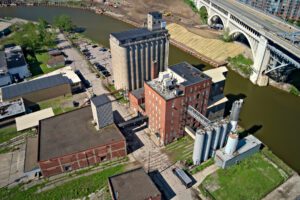
Caption: A long perspective view of the mill stretching along the Cuyahoga, framed by steel bridges and rail lines.
A Mill That Moved with the City
This stretch of riverfront was no accident. The location of the mill — historically operated by companies like International Milling Company and later Grain Craft — allowed it to interface directly with waterborne freight on the Cuyahoga and rail lines leading out to the rest of Ohio and beyond. Flour and grain moved in and out of this site efficiently, with shipping routes tying Cleveland’s local industries into national systems of food production and distribution.
The architecture reflects this function. Tall silos, freight doors, skywalks over active rail lines — every structure here had a purpose, and those layers still read clearly even in their weathered condition.
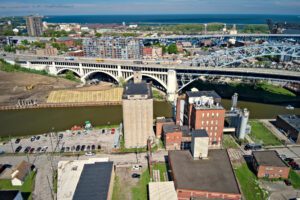
Caption: View from the tracks below the Detroit–Superior Bridge, where freight once crossed beneath the mill’s walkways.
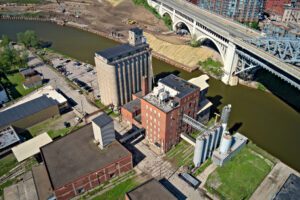
Caption: A closer look at the fading painted signage and the mill’s steel service structures.
Cleveland’s Riverfront Then and Now
For decades, this area of the Flats was driven by function, not form. What mattered was utility — getting goods from rail to river, processing materials, and moving product efficiently. Over time, as industries shifted or disappeared, these buildings became symbols of another era. Many were demolished or left to decay.
The Grain Craft Mill, however, held on.
Even as nearby developments pushed forward with housing, trails, and entertainment, the mill remained mostly untouched — a striking contrast to the modern reinvention of the Flats East Bank and the Towpath Trail extension nearby.
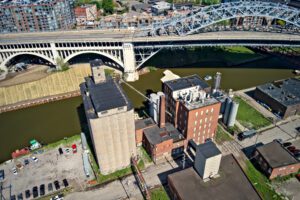
Caption: Aging infrastructure and rusted surfaces stand in quiet contrast to newer developments nearby.
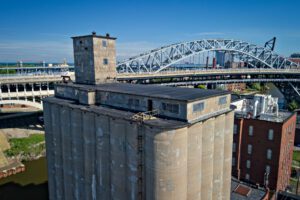
Caption: The mill’s west end, looking toward the Detroit–Superior span with its twin decks for rail and road traffic.
A New Chapter with Cleveland Metroparks
In late 2023, the story of this site took a new turn. Cleveland Metroparks acquired the 3.3-acre property for $3.5 million with a clear purpose: transforming this industrial relic into accessible public greenspace.
Their vision includes:
-
Stabilizing the riverbank, which has been eroding in recent years.
-
Opening new trails to connect Ohio City, the Flats, and nearby neighborhoods.
-
Preserving the site’s history while adapting it for future use.
This initiative is part of a larger push by Metroparks to reclaim overlooked corners of Cleveland’s waterfront — places that once powered industry and now offer potential for recreation, education, and community gathering. It’s not just about cleanup or beautification. It’s about honoring what was while planning for what’s next.
Metroparks info: SOURCE
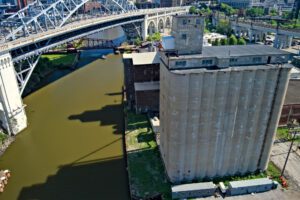
Caption: A sweeping view of the entire mill property from the opposite riverbank.
The Value of Preservation
Sites like this don’t get rebuilt. Their scale, materials, and context belong to a specific era in Cleveland’s evolution — one where grit and grain shaped the skyline.
As visual storytellers, we believe documenting these spaces matters. Not to romanticize decay, but to recognize its place in the timeline. The mill might not always look the way it does now. But for the moment, it stands. And in its silhouette, Cleveland’s past — and future — both come into view.
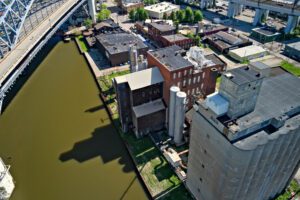
Caption: Detail of an elevator shaft rising above the roofline.
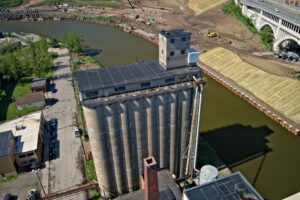
Caption: Vegetation creeping into the foundation — a subtle sign of time moving forward.
More Than Just a Building
This project isn’t about nostalgia. It’s about legacy. It’s about asking how we move forward in ways that respect where we’ve been. The Grain Craft Mill represents that crossroads — where industry meets ecology, and where structure meets storytelling.
We’ll be keeping an eye on this transformation and continuing to document Cleveland’s evolving riverfront as it shifts from utility to experience.
Interested in more local industrial stories or want to explore how we document change through visuals? Reach out to us here